> For the complete documentation index, see [llms.txt](https://ykkim.gitbook.io/EC/llms.txt). Markdown versions of documentation pages are available by appending `.md` to page URLs; this page is available as [Markdown](https://ykkim.gitbook.io/EC/numerical-programming/ta-tutorial/tutorial-curve-fitting.md).
# Tutorial: Linear Regression
Least Squares Regression
## Part 1: Linear Regression (line)
### Problem
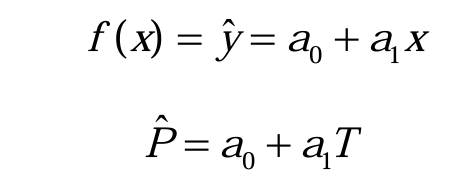
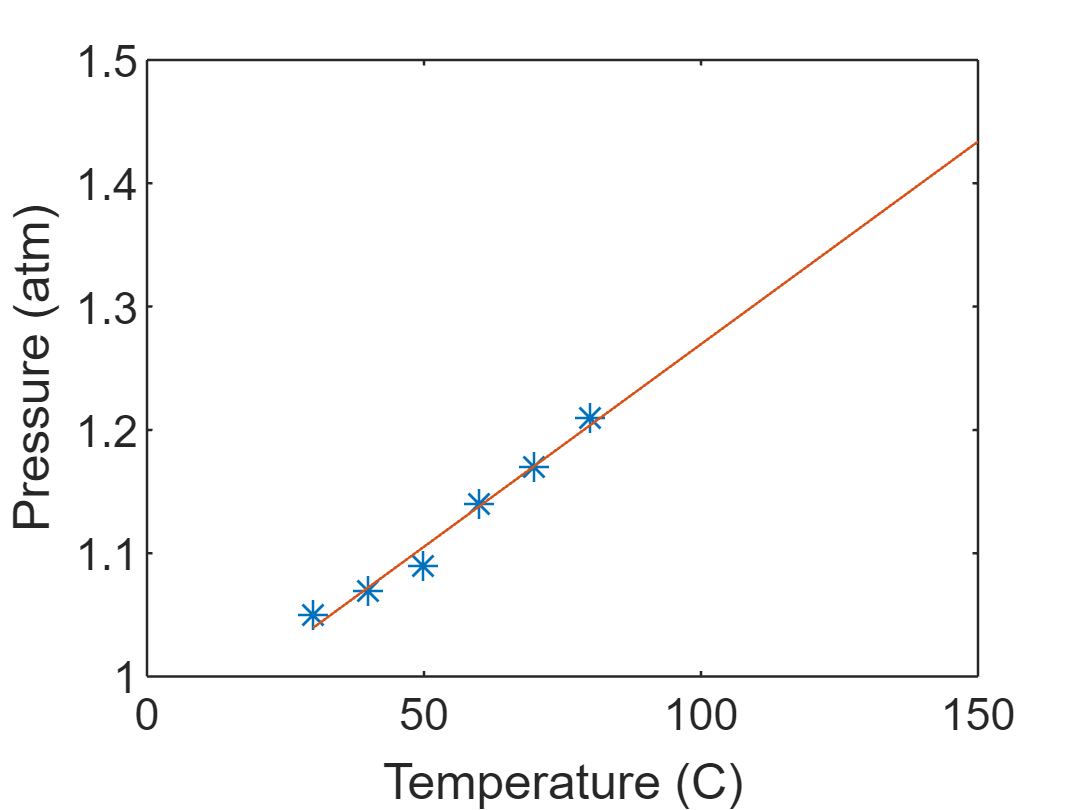
#### Predict the pressure if the temperature is increased to 150C based on Charles's law for ideal gas P=kT, where k is a constant.
### Tutorial: Matlab
### Exercise: MATLAB
Download the tutorial source file
* [TU\_Curvefitting\_student\_2024.mlx](https://github.com/ykkimhgu/NumericalProg-student/blob/main/tutorial/TU_Curvefitting/TU_Curvefitting_student_2024.mlx)
Fill-in the blanks to create `function [a0,a1] = linearFit(X, Y)`
###
### Exercise: C
Download the tutorial source code
* [Assignment\_LinearRegression\_student.cpp](https://github.com/ykkimhgu/NumericalProg-student/blob/main/src/Assignment_LinearRegression_student.cpp)
Fill-in the blanks to create functions that calculates coefficients of least squares regression (line)
`void linearRegression (double z_opt[], double xdata[], double ydata[], int dataN)`
***
## Part 2: Higher-order polynomial curve fitting (Optional)
### Problem
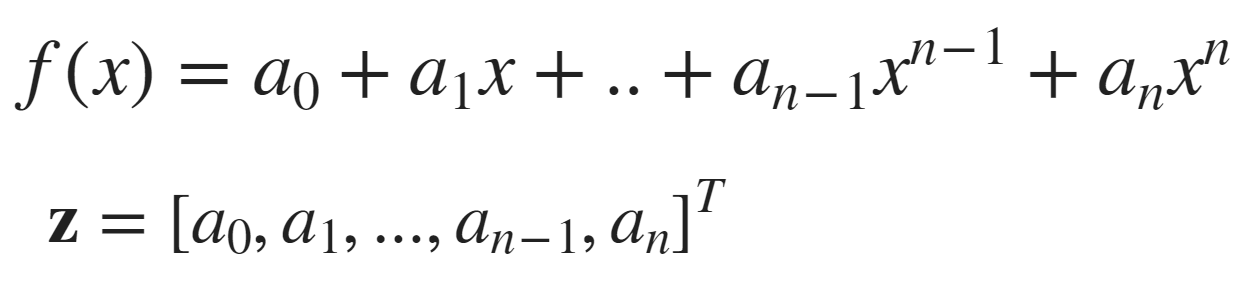
Find the optimal higher-order polynomial to fit the given dataset. assume the model has n=4 order polynomial form
### Exercise: MATLAB
```matlab
Xdata = 0:0.4:6;
Ydata = [0, 3, 4.5, 5.8, 5.9, 5.8, 6.2, 7.4, 9.6, 15.6, 20.7, 26.7, 31.1, 35.6, 39.3, 41.5];
% MATLAB function of curvefitting
% z=[an,..., a1, a0];
% polynomial order n=4
n=4;
Z=polyfit(Xdata,Ydata,n)
% yhat on the fitted curve:
% yopt=Z(5).*(x.^4) +...+ +Z(0);
Yopt=polyval(Z,Xdata);
figure
plot(Xdata,Ydata, '*r')
hold on
plot(Xdata,Yopt, '-b')
xlabel('strain','fontsize',15)
ylabel('stress','fontsize',15)
title('Polyfit')
```
### Exercise: C (optional)
Fill-in the blanks to create functions that calculates coefficients of least squares regression of Nth order polynomial
Download the tutorial source code
* [Assignment\_CurveFit\_student.cpp](https://github.com/ykkimhgu/NumericalProg-student/blob/main/src/Assignment_Curvefit_student.cpp)
`void polyFit(double vecZ[], double vecX[], double vecY[], int n);`
If you choose to use Matrix structure
`Matrix polyFit_mat(Matrix _vecX, Matrix _vecY, int n);`
	double T[] = { 30, 40, 50, 60, 70, 80 };
	double P[] = { 1.05, 1.07, 1.09, 1.14, 1.17, 1.21 };
	double Z_Q1[2] = { 0 };
	int n = 1;	// nth order
	int m_Q1 = 6;	// length of dataset

	// Option 1: using 1D array
	n = 1;
	polyFit(Z_Q1, T, P, n);

	// Option 2
	// Delete the below if you selected Option 1
	Matrix matT = arr2Mat(T, m_Q1, 1);
	Matrix matP = arr2Mat(P, m_Q1, 1);
	Matrix vecZ_Q1 = polyFit_mat(matT, matP, n);
	printMat(vecZ_Q1, "Z_Q1");